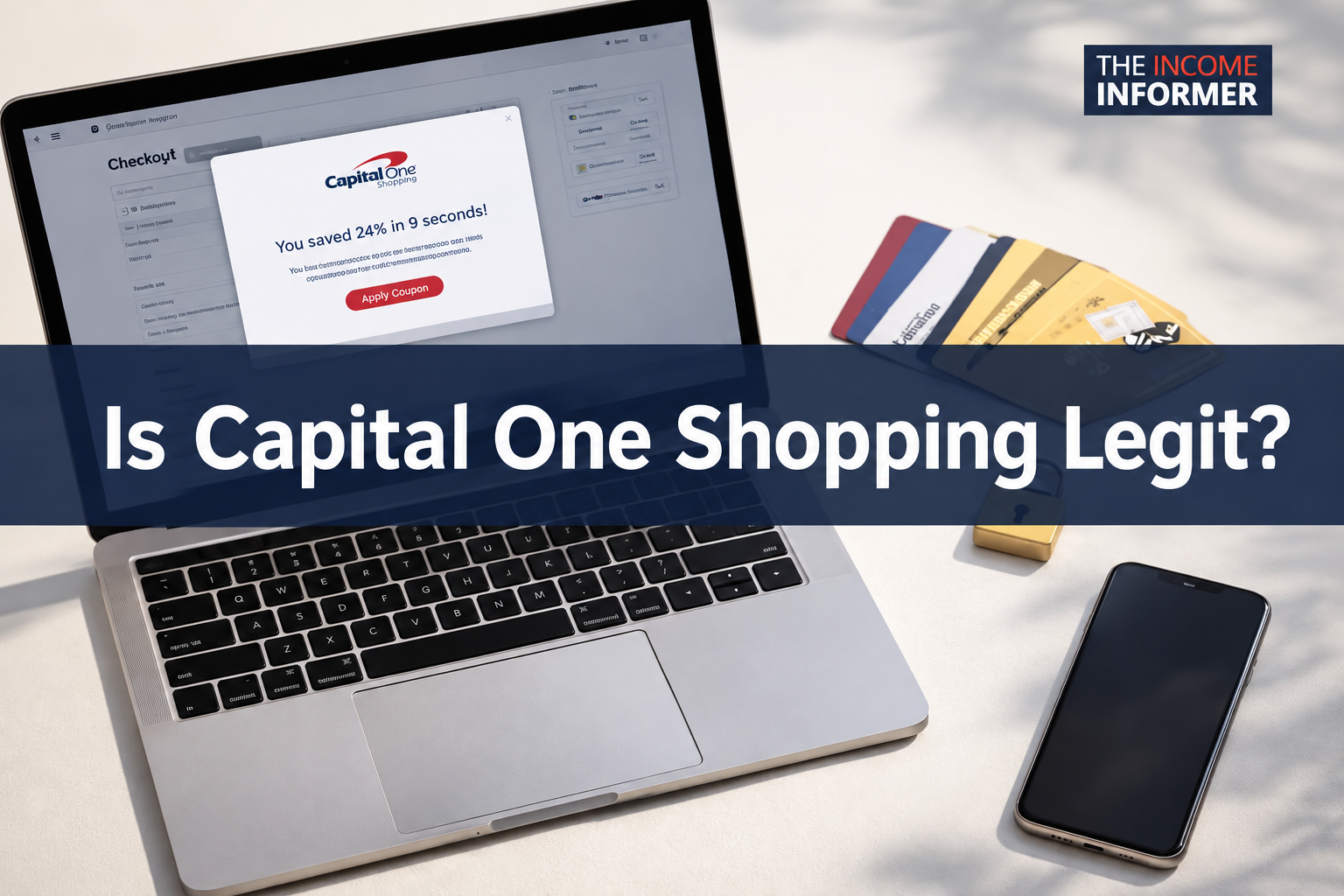
Yes, Capital One Shopping is legit. It’s a real browser extension and app owned by Capital One (acquired from Wikibuy in 2018), it’s free to use, and it genuinely applies coupon codes and compares prices while you shop. The honest catch: you are paid in gift card credits, not cash, payouts can take weeks, and the extension tracks a lot of your shopping behavior to make the whole thing work. So it’s legitimate, but whether it’s worth it depends on how you feel about trading browsing data for modest savings.
Key Takeaways
- It’s a real product from a real bank. Capital One Shopping is operated by Capital One and governed by its own Capital One Shopping privacy policy, separate from the bank’s main banking policy.
- It’s 100% free. No fees, no subscription, no premium tier. Capital One earns affiliate commissions from merchants.
- You do NOT need a Capital One credit card. Any card, any bank, any debit card works.
- Rewards come as gift card credits, not direct cash, this is the single biggest complaint.
- Coupon-finding and price comparison are the real strengths, not the cash back rate.
- It collects a lot of data: the URLs you visit on supported shopping sites, order details, device info, and more.
- Payout timing is slow, credits typically unlock after a merchant’s return window closes, often 30 to 60+ days.
- Common complaints include missing rewards, accounts closed without warning, and “best price” results that aren’t always the best.
- Better for pure cash back? Rakuten, Honey, or a straight cash-back card often beat it.
Let me be straight with you: I’ve tested a lot of “free money” tools for this site, and most of them fall apart the moment you try to cash out. Capital One Shopping doesn’t fall apart. It just isn’t the jackpot some of its marketing implies.
What is Capital One Shopping and how does it work?
Capital One Shopping is a free browser extension and mobile app that automatically hunts for coupon codes, compares prices across other online sellers, and awards gift card credits when you buy from partner merchants. Capital One explains the product on its own Capital One Shopping overview page.
It started life as Wikibuy, an independent price-comparison startup, before Capital One acquired it in 2018 and rebranded it. That history matters because it explains why the tool feels more like a shopping engine than a bank product.
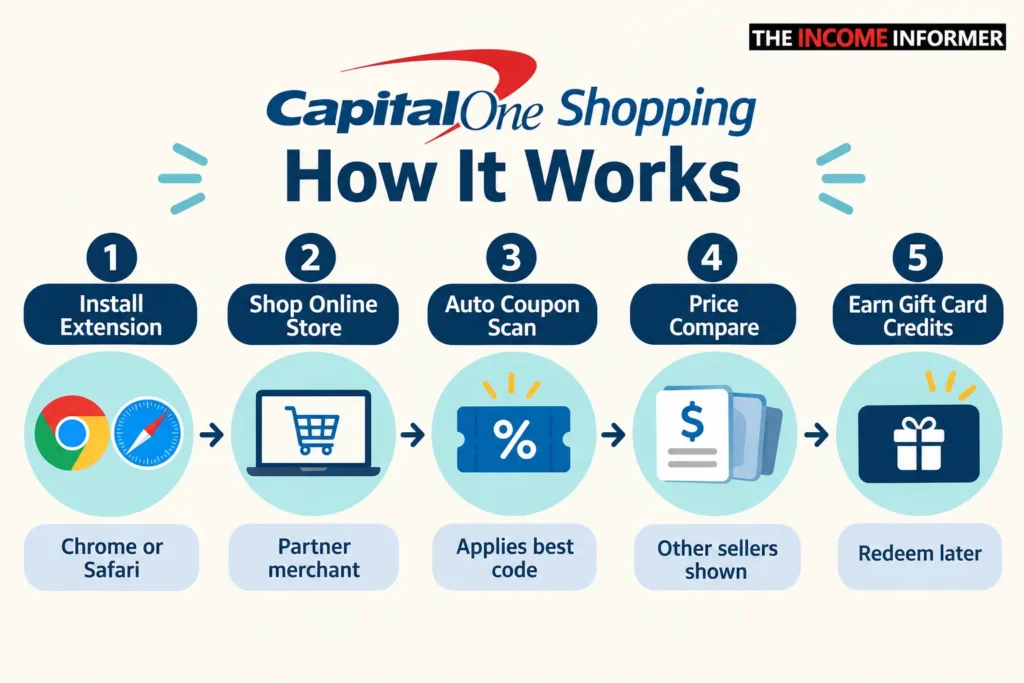
Here’s the mechanic in plain terms:
- You install it on Chrome, Edge, Firefox, or Safari (or download the mobile app).
- You shop normally at a supported retailer.
- At checkout, it auto-tests coupon codes and applies whichever one saves the most.
- On product pages, it shows competing prices from other sellers, including shipping and tax estimates.
- If the retailer is a rewards partner, you earn “Shopping Credits” that convert into gift cards.
The core trade: Capital One Shopping earns affiliate commission when you buy through its links. It shares a slice of that with you as gift card credits. You’re not getting free money, you’re getting a cut of a marketing fee.
Decision rule: If you shop online at major retailers more than two or three times a month, the coupon-finder alone usually justifies the install. If you shop online rarely, the data trade-off isn’t worth it.
Is Capital One Shopping legit, or is it a scam?
Capital One Shopping is legitimate, not a scam. It’s operated by a publicly traded, federally regulated bank, it publishes real terms of service and a real help center, and users do receive gift cards. There’s no hidden fee, no bait-and-switch payment, and no fake “processing” wall like you’d see with sketchier reward apps.
The scam suspicion usually comes from three places:
- It sounds too good. “Free money for shopping” triggers the right instincts.
- The payouts are small. People expect dollars and get a few bucks in gift card credit.
- Negative reviews exist. On Trustpilot, reviews for Capital One Shopping are mixed, with a cluster of complaints about missing rewards and closed accounts.
Being legitimate and being generous aren’t the same thing. The tool does what it says. It just does less than people hope.
If you compare it to the genuinely questionable corner of this space, things I’ve dug into like whether Flash Rewards actually pays out, Capital One Shopping is on a completely different tier of trustworthiness.
Does Capital One Shopping actually save you money?
Yes, for most online shoppers, but usually in small, inconsistent amounts. The savings come mostly from coupon codes you wouldn’t have found yourself, not from the cash back rate. The average user is realistically looking at a few dollars per order, sometimes zero.
Where it actually helps:
- Coupon stacking at checkout. This is its strongest feature. It tests dozens of codes in seconds.
- Price comparison on big-ticket items. On electronics and appliances, finding a seller $40 cheaper is a real win.
- “Watch this item” alerts for price drops, which is handy for non-urgent purchases.
Where it disappoints:
- Grocery, pharmacy, and small-merchant purchases rarely trigger anything.
- Rewards rates are modest compared to a good cash-back credit card.
- It double-counts “savings” in its own dashboard sometimes, showing coupon savings you’d have gotten anyway from a site-wide sale.
Common mistake: Treating the extension’s “total saved” number as real savings. Much of it reflects discounts already available on the page. Judge it by what you actually banked in gift cards.
Is Capital One Shopping safe to use?
Capital One Shopping is safe from a security standpoint. It doesn’t ask for your bank login, it doesn’t store your full card number, and it doesn’t need access to your Capital One account to function. Capital One documents its broader security approach across its privacy and security resources.
What it does and doesn’t touch:
| What it accesses | What it does NOT access |
|---|---|
| URLs on supported shopping sites | Your bank login credentials |
| Order confirmations and totals | Your full credit card number |
| Device and browser information | Your email inbox contents |
| Items viewed and carted | Non-shopping browsing (per policy) |
| Your account email and password for the extension | Your credit score or credit report |
The honest risk isn’t theft, it’s visibility. A browser extension with permission to read pages on shopping sites is, by design, watching a lot. That’s a privacy question, not a security one. The two get confused constantly.
Edge case worth knowing: If you share a computer, your shopping history and reward balance are visible to whoever uses that browser profile. Log out or use a separate profile on shared machines.
What data does Capital One Shopping collect about me?
Capital One Shopping collects a broad set of shopping-behavior data: pages you visit on supported retail sites, products you view, cart contents, purchase amounts, order confirmation details, device identifiers, IP address, and approximate location. All of this is spelled out in the Capital One Shopping privacy policy, which is deliberately kept separate from the bank’s online privacy policy.
Key points from reading the actual policies:
- It is its own privacy regime. Signing up for the extension does not fold your shopping data into your banking profile automatically, but data can be shared with Capital One affiliates as described in the policy.
- Third-party advertising and analytics partners are involved. The policy permits sharing for targeted advertising, which is why independent privacy reviewers tend to flag it.
- Canadian users fall under a different framework, covered by the Capital One Canada privacy policy, including how data is used for personalization.
- You can opt out of certain sharing and request deletion, but doing so limits how well the tool functions.
My honest take: Capital One Shopping isn’t hiding anything. The policy is unusually readable for a bank product. But “disclosed” isn’t the same as “minimal.” This extension sees your shopping life.
If you’re privacy-sensitive, read the policy yourself before installing, the same way I’d tell you to read our own privacy policy before trusting any site with your email.
Is Capital One Shopping free, or does it charge fees?
It’s completely free. There are no installation fees, no subscription tiers, no withdrawal fees, and no minimum spend requirement to join. Capital One monetizes through merchant affiliate commissions, which is the standard model for every coupon extension.
What you “pay” instead:
- Your shopping data, used for personalization and advertising.
- Your purchase routing, clicking through its links means Capital One gets credit for the sale.
- Occasional friction from popups at checkout.
No credit check. No application. No card number required to sign up.
Do you need a Capital One credit card to use Capital One Shopping?
No. You don’t need a Capital One credit card, a Capital One bank account, or any relationship with the bank. Anyone with an email address can sign up and earn rewards.
This trips people up constantly. Capital One does publish guidance on credit cards for online shopping and on applying for a credit card online safely, and the extension does occasionally promote Capital One card offers. But those are marketing, not requirements.
Can you use Capital One Shopping with any credit card?
Yes, with any card from any issuer, plus debit cards, PayPal, and most other checkout methods. The extension works at the merchant level, not the card level. It doesn’t see or need your payment method to apply a coupon or credit your rewards.
Smart stacking move: Use Capital One Shopping for the coupon, then pay with your highest-earning cash-back or travel card. The rewards don’t conflict. That’s where the real combined savings live.
Which stores and merchants accept Capital One Shopping?
Capital One Shopping works with thousands of major U.S. online retailers, covering most of the big names in electronics, apparel, home goods, travel booking, and office supplies. Coverage skews heavily toward large national brands.
Typical categories with strong coverage:
- Big-box and department stores
- Electronics and computer retailers
- Clothing, shoes, and beauty brands
- Office and school supplies
- Hotel and travel booking sites
- Pet supplies and home improvement
Where coverage is thin or absent:
- Grocery delivery and local services
- Small independent shops and Shopify one-offs
- Most resale marketplaces, though if you shop secondhand, our breakdowns of whether Mercari is legit and whether Poshmark is legit are more useful than any extension
- Subscription services and digital-only purchases
Amazon deserves a note: the price-comparison feature points you away from Amazon to cheaper third-party sellers, which is genuinely useful but also means Amazon purchases themselves usually don’t earn credits.
How much cash back do you actually earn with Capital One Shopping?
Realistically, most users earn a modest amount, typically low single-digit percentages at participating merchants, delivered as gift card credits rather than cash. It’s supplemental, not an income stream.
A grounded expectation:
- Light online shoppers (a few orders a month): a gift card or two per year.
- Heavy online shoppers who always route through the extension: meaningfully more, but still measured in tens of dollars, not hundreds.
- One big electronics purchase with a good coupon can out-earn six months of small orders.
Don’t confuse credits with cash. Shopping Credits convert to gift cards at major retailers. If you’d never shop at those retailers, the credits are worth less to you than their face value suggests.
If you’re chasing actual spendable money, the honest answer is that a cash-back card plus a real side income beats any coupon extension. That’s why I keep pointing readers toward legitimate work from home jobs rather than reward-app grinding, those are proven ways to move real numbers.
How long does it take to get your Capital One Shopping rewards?
Expect 30 to 60 days or more before credits become redeemable. Rewards appear as “pending” shortly after a qualifying purchase, then unlock only after the merchant confirms the sale and the return window closes.
The typical timeline:
| Stage | Usual timing |
|---|---|
| Credit appears as pending | A few hours to a few days |
| Merchant confirms the order | 1 to 2 weeks |
| Return window clears | 30 to 60 days |
| Credits redeemable for gift cards | After confirmation clears |
| Gift card delivery (email) | Usually within minutes to 48 hours |
Why it feels slow: Affiliate networks pay Capital One on a delay too. The lag isn’t the bank stalling, it’s how the entire affiliate industry settles. The Capital One Shopping help center is where you file a missing-reward claim, and you generally need your order confirmation to do it.
Why isn’t Capital One Shopping showing discounts on my purchases?
The most common reasons are that the merchant isn’t a partner, the extension was blocked or outdated, or another affiliate cookie overwrote the tracking. It’s rarely a bug on your account.
Run through this checklist:
- Is the store a partner? No partnership, no credits or coupons.
- Did you click through from a different coupon site first? The last affiliate link wins. Only one tool can get credit.
- Is the extension enabled for that site? Check your browser’s extension permissions.
- Are you using a strict ad blocker or private window? Both can break tracking.
- Is the extension updated? Old versions silently fail on redesigned checkout pages.
- Did you apply a different promo code manually? That can void reward eligibility at some merchants.
- Was the item excluded? Gift cards, taxes, shipping, and some brands are usually excluded.
Biggest avoidable mistake: Running two coupon extensions at once. They fight over the affiliate cookie and you often end up earning from neither.
Capital One Shopping vs Rakuten: which rewards app is better?
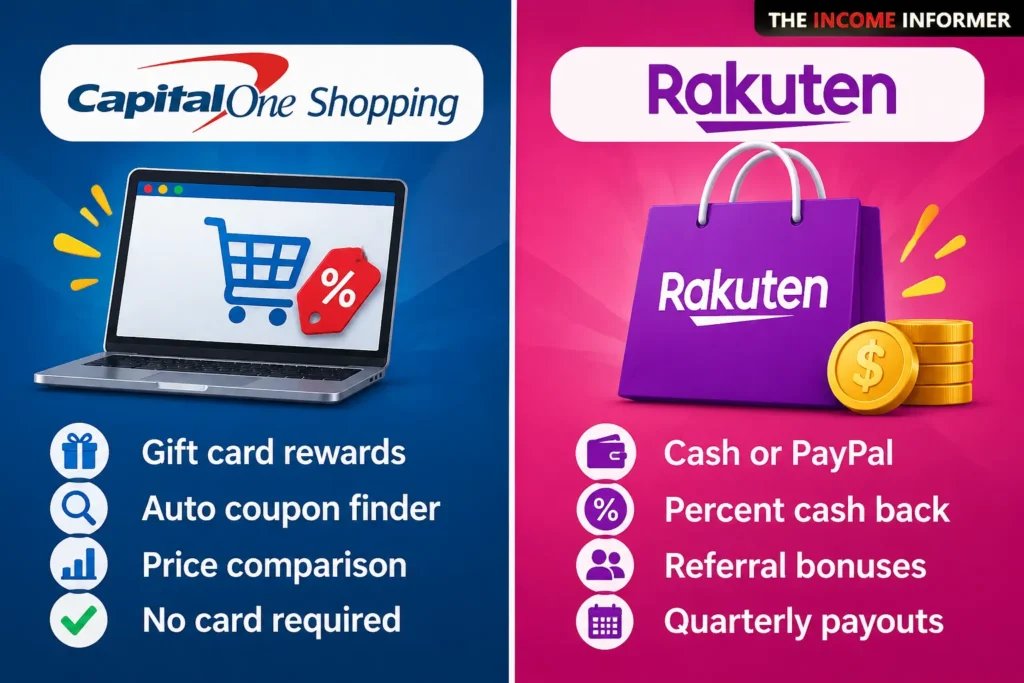
Rakuten is better if you want real cash. Capital One Shopping is better if you want automatic coupon-finding and price comparison. They solve different problems, and plenty of people use both, just not on the same purchase.
| Feature | Capital One Shopping | Rakuten |
|---|---|---|
| Payout type | Gift card credits | Cash (PayPal or check) |
| Auto coupon finder | Strong, automatic | Weaker |
| Price comparison | Yes, a core feature | No |
| Payout schedule | Rolling, after return window | Quarterly “Big Fat Check” |
| Cash back rates | Modest | Often higher, with boosted events |
| Signup bonus | Occasional | Frequent referral bonuses |
| Card required | None | None |
Choose Capital One Shopping if you hate hunting for promo codes and you buy electronics or appliances where price comparison matters.
Choose Rakuten if you want spendable cash and you shop at its higher-rate partners. Our full Rakuten review covering whether it’s legit walks through its payout quirks in detail.
Choose both if you’re willing to check which one has the better rate at that specific store before clicking.
What are the common complaints about Capital One Shopping?
The recurring complaints fall into four buckets: rewards that never credit, accounts closed without explanation, gift-card-only payouts, and price comparisons that aren’t actually the best price. These show up consistently in app store reviews and on Capital One Shopping’s Trustpilot page.
Breaking them down honestly:
- Missing rewards. The most frequent issue. Usually traceable to cookie conflicts or non-partner merchants, but support resolution can be slow and inconsistent.
- Sudden account closures. A smaller but loud group reports accounts closed with pending credits forfeited, typically tied to terms violations the user says they didn’t commit.
- Gift cards instead of cash. Not a flaw, exactly, it’s disclosed. But it’s the single most common source of disappointment.
- “Best price” that isn’t. Comparison results sometimes exclude shipping surprises or point to lesser-known sellers with weak return policies.
- Checkout popups that interrupt the buying flow.
- Privacy discomfort once users read the extension’s permissions.
Edge case: Returning an item after your credit has cleared can result in a clawback. Don’t spend credits on purchases you might reverse.
Is Capital One Shopping worth it according to Reddit?
Reddit’s consensus is roughly “useful, not amazing.” The common sentiment across personal finance and frugal communities is that the coupon-finder is worth keeping installed, the cash back is underwhelming compared to Rakuten or a good credit card, and the privacy trade-off bothers a meaningful minority of users.
The recurring Reddit themes I’ve seen echoed:
- Keep it for coupon automation, don’t count on it for earnings.
- Several users report good one-off wins on large purchases.
- A visible group uninstalled it over data collection after reading the permissions.
- Frustration with support responsiveness on missing credits is widespread.
Treat Reddit as directional, not definitive, selection bias means angry users post more than satisfied ones. But the pattern here matches the app store reviews, which makes it more credible than usual.
Best alternatives to Capital One Shopping
If gift cards or privacy are dealbreakers, there are solid alternatives. The right pick depends on whether you want cash, deeper coupon coverage, or simply less tracking.
- Rakuten, best for actual cash payouts at major retailers.
- Honey (PayPal), comparable coupon automation, similar data trade-offs.
- A flat-rate cash-back credit card, the simplest, most reliable 2% on everything, no extension required.
- Store loyalty programs, zero third-party tracking, often better per-dollar value.
- Manual coupon sites, slower, but you control what’s installed in your browser.
- Earning instead of saving, if you’re in a tight spot, trimming $3 off an order won’t fix it. Our guide on how to make $500 fast through legitimate ways is a better use of an afternoon.
Decision rule: Want cash → Rakuten or a cash-back card. Want convenience → Capital One Shopping or Honey. Want maximum privacy → no extension at all, plus loyalty programs.
My verdict: who should actually install it
Capital One Shopping is a legitimate, free, well-built tool that reliably does two things well, finding coupon codes and comparing prices, while paying modest gift card rewards on top. It is not a cash-back powerhouse, and it collects a lot of shopping data to deliver its value.
Install it if you:
- Shop online at major retailers regularly
- Buy electronics or appliances where price comparison pays off
- Don’t want to manually hunt for promo codes
- Are comfortable with shopping-behavior tracking
Skip it if you:
- Want cash, not gift cards
- Shop mostly at small or local merchants
- Are privacy-conscious about browser extensions
- Already run Honey or Rakuten and don’t want cookie conflicts
FAQ
Is Capital One Shopping legit? Yes. It’s a genuine, free browser extension and app owned by Capital One, with published terms, a real help center, and verified gift card payouts. It’s legitimate, though its rewards are modest.
Does Capital One Shopping cost anything? No. It’s free with no fees, subscriptions, or minimum spend. Capital One earns affiliate commissions from merchants instead.
Do I need a Capital One account or card? No. Any email address works. You don’t need a Capital One credit card, bank account, or credit check.
Does Capital One Shopping pay cash? No. Rewards are issued as Shopping Credits redeemable for gift cards at major retailers, not as cash or direct deposit.
How long until I can redeem rewards? Usually 30 to 60 days. Credits stay pending until the merchant confirms the purchase and the return window closes.
Is the extension safe to install? Yes, from a security standpoint. It doesn’t access bank logins or full card numbers. The real consideration is privacy, it reads pages on supported shopping sites.
Can it hurt my credit score? No. Using Capital One Shopping involves no credit check and has zero impact on your credit score.
Why didn’t I get rewards on my order? Most often the merchant isn’t a partner, another coupon extension overwrote the tracking cookie, or the item category was excluded. File a claim through the help center with your order confirmation.
Can I use it with Amazon? Partially. It compares Amazon prices against other sellers, but Amazon purchases themselves typically don’t earn Shopping Credits.
Is Capital One Shopping better than Rakuten? For coupons and price comparison, yes. For actual cash back, Rakuten usually wins. Many people use both, just not on the same purchase.
Can Capital One see my shopping data in my banking profile? The shopping product runs under its own privacy policy, separate from the bank’s. Data can be shared with Capital One affiliates as disclosed in that policy, so read it before installing.
How do I delete my account and data? Through account settings in the extension or app, with data deletion requests handled under the privacy policy’s consumer rights section.
Conclusion
Capital One Shopping passes the legitimacy test without much argument. It’s a real product from a regulated bank, it costs nothing, it works with any credit card, and it actually delivers the gift cards it promises. The disappointments are honest ones: gift cards instead of cash, slow payout timing, inconsistent crediting, and a data footprint that’s broader than most people expect from a “coupon tool.”
Here’s what I’d actually do:
- Install it on a browser you use for shopping only, not your main everyday profile.
- Run it alone, don’t stack it with Honey or Rakuten on the same purchase.
- Use it mainly for coupons and price checks, and treat the rewards as a bonus.
- Pay with your best cash-back card on top of whatever coupon it finds.
- Read the privacy policy before you commit, and opt out of ad sharing if that matters to you.
- Keep order confirmations for 60 days so you can claim missing credits.
And if you landed here because money’s tight rather than because you’re optimizing a hobby, be realistic: saving $4 at checkout is nice, but earning is where the leverage is. Browse our honest reviews of money-making apps and platforms and focus on the ones that pay in cash, not credits.